
Pankaj Sharma
Product & Technology
Builds the agents, the approval gates around them, and the record every run leaves behind. Designs the system so nothing sends, posts, or merges without a human click.
LinkedInAgents do the work. Your team stays in control.
Start with a free scan of your last 90 days. Your claims, your number — with the source records behind every line. Built for pharmacies, chiropractors, and medical practices.
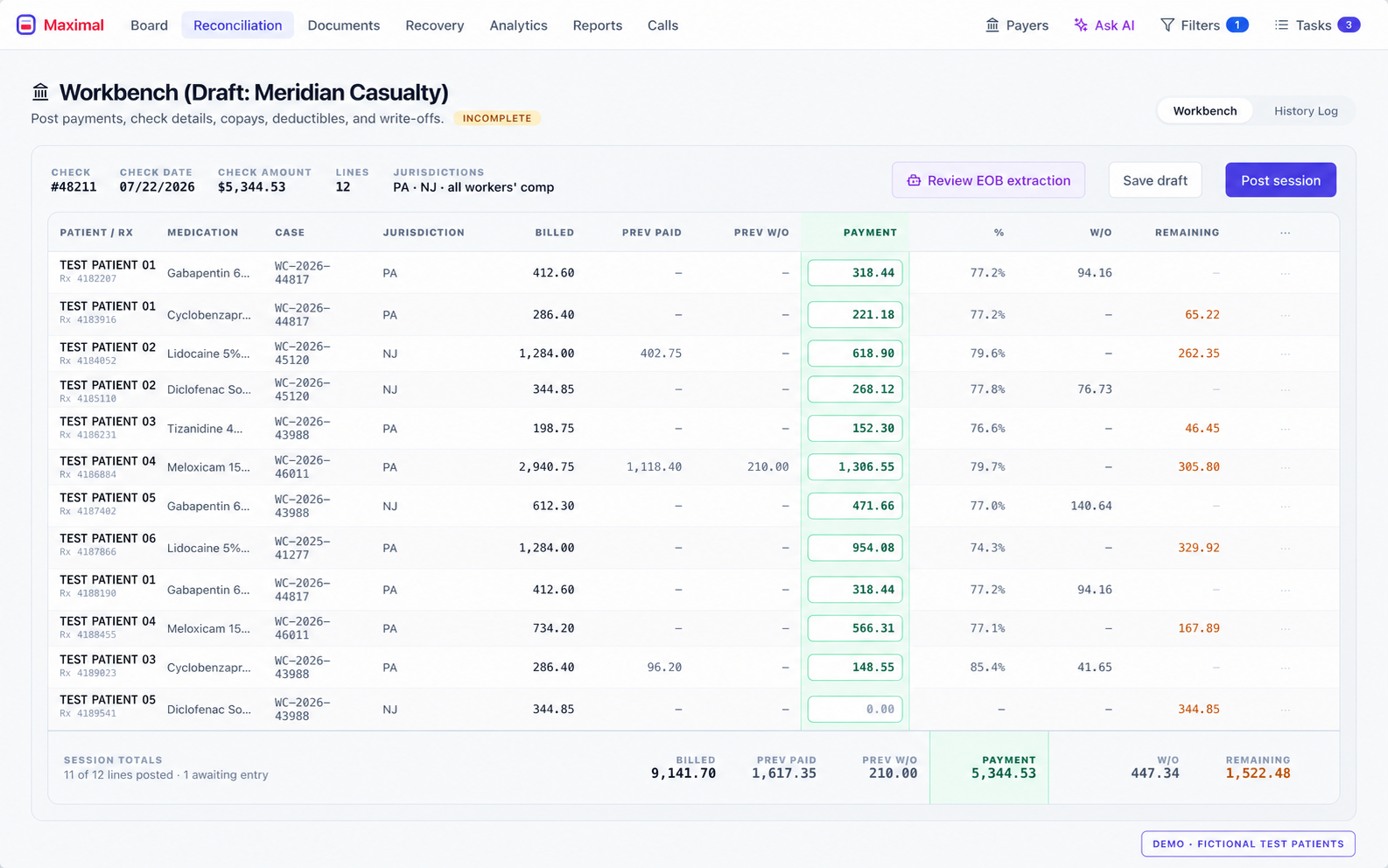
The Reconciliation Workbench — bulk EOBs split, extracted, and matched into a draft your reconciler reviews line by line. Illustrative screen with clearly labeled fictional test patients.
None of the three show up as a line on your P&L. That's exactly why they persist.
Adjudicated claims that quietly came back short — and nobody reconciled them line by line.
Money already in your account that a PBM audit could claw back — visible only if something is watching for it.
Injury claims — workers' comp, PI, PIP scripts and treatments — refused at the counter or billed as commercial and written down. Not because the volume isn't there, but because the paperwork isn't worth it without dedicated billers.
We don't ask you to take any of this on faith. The Revenue Opportunity Assessment reads your own last 90 days and comes back with the number — every dollar traceable to a claim you can open.
Nobody buys a billing platform on day one. You start with a free scan of your own claims, and every rung after it is a decision you make with your own numbers in hand.
Free. Start here. A one-time scan of your last 90 days. Recoverable dollars, ranked, with the source claims attached to every line — plus the injury read: scripts and encounters that carried injury indicators but were billed commercial or turned away.
The scan becomes a nightly habit. Money you're owed and money a PBM audit would put at risk, ranked and waiting each morning — with a monthly page proving what came back. In design now; we're choosing the first design partners.
Turn the injury scripts on without hiring a biller. Flag a script at the counter; agents build the forms and set the deadline clocks; you approve. The billing engine underneath is live in production — the tier packaging is what's new.
The full platform for a material workers' comp / PI / PIP book. Four agents run the lifecycle from intake to cash; your team gates every consequential action.
Straight about where each rung stands: the Assessment and the Billing platform are running today. Recover is designed and specified, not yet built. Injury Desk is a new packaging of a billing engine that is already in production. We would rather tell you that here than have you find it out in a demo.
Everyday pharmacy revenue — the money leaking out of claims you already filled, and the exposure a PBM audit would find. Read-only by design: it finds, ranks, and proves. It never acts on your behalf. In design now, with design partners being selected.
The injury claim itself — workers' comp, PI, and PIP billed correctly, start to finish, by agents your team approves. Entered through Injury Desk or head-on, depending on your volume.
| Traditional software | Outsourced service | Maximal | |
|---|---|---|---|
| Built for | Commercial claims; injury is an edge case | Whatever the contract says | The injury claim, natively |
| Who does the work | Your staff, inside the software | Someone else's staff, opaquely | AI agents — your team approves |
| Form prep | Templates you fill in | They fill in | Generated, vision-QA'd, batched |
| EOB posting | Manual keying | Manual keying (theirs) | Extracted by agent, review-gated |
| Silent claims | Nobody notices | Depends on their diligence | Surfaced against your own threshold |
| Visibility | Reports after the fact | Monthly summary | Live board + per-claim timeline |
| Cost shape | License + your labor | % of collections, forever | Software + much smaller labor |
Checks the claim, auto-fills from patient history, generates CMS-1500 + state forms, inspects its own output with AI vision QA, assembles the batch, and requests approval to send.
Splits bulk EOB scans into claim-level PDFs, extracts every payment line, matches to claims and meds, and drafts postings your reconciler accepts, remaps, or rejects line-by-line. Contracted as the “EOB Agent.”
Watches every submitted claim and opens a follow-up with full context when a payer goes past your window. The follow-up queue is built and gated, not yet in production; AI status calls over payer IVR trees stay parked until a partner asks for them.
Answers plain-English questions against your live claims and financials, and proposes profile cleanups — duplicate payer and provider merges — for your approval.
Nothing leaves the building — no batch sent, no posting made, no merge applied — without a person clicking approve.
Billing, EOB, Follow-up, and Data agents draft the work and stage it for review.
Two clicks: approve or reject. Approval-gated by architecture — no exceptions.
Batch sent · posting made · merge applied — only now, with a name attached.
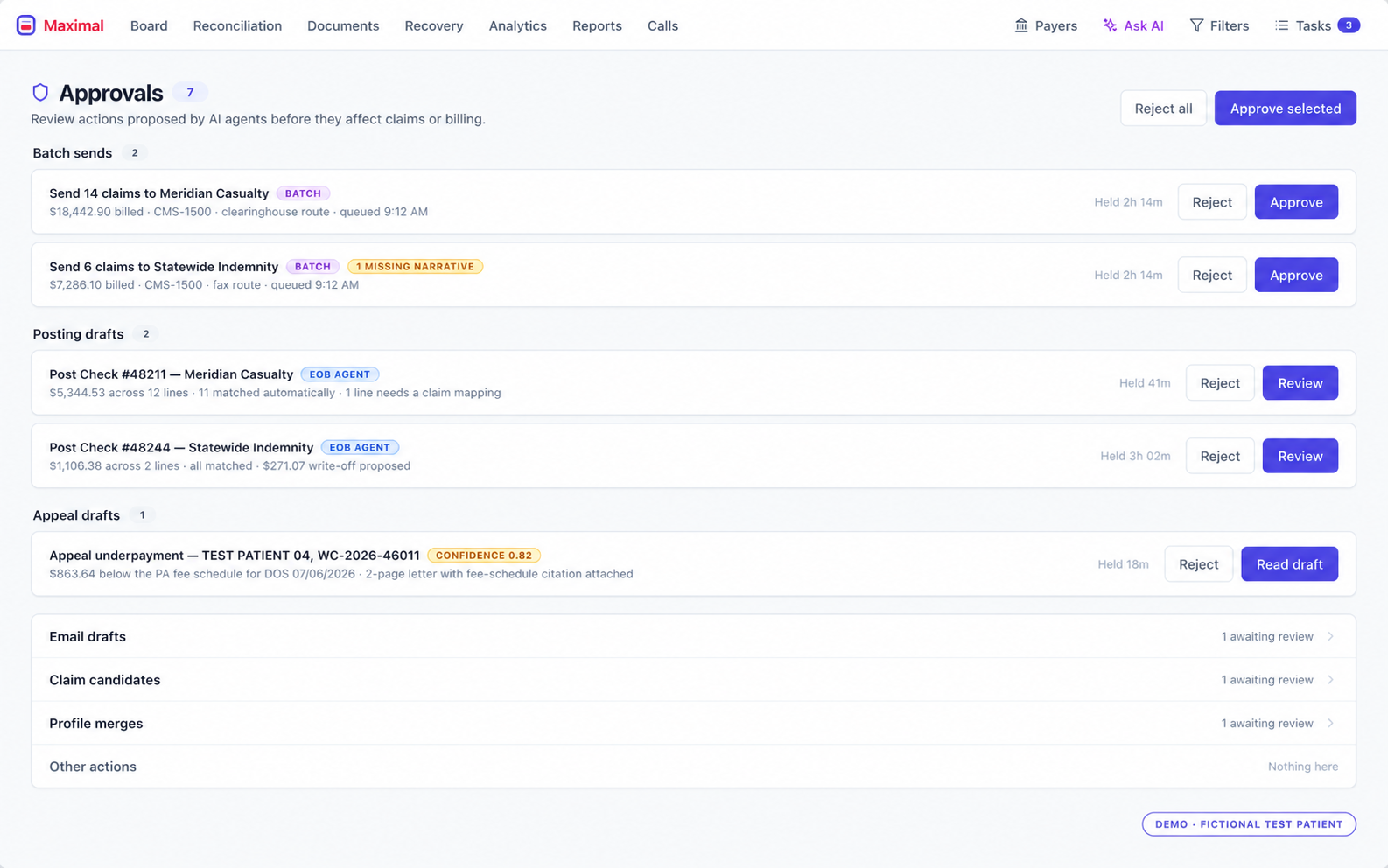
One approvals queue — batch sends, posting drafts, appeal drafts. Approve or reject in two clicks. The approval gate itself is live and enforced today. Fictional test data shown.
Four surfaces your team actually lives in, and one gate that everything consequential has to pass through.
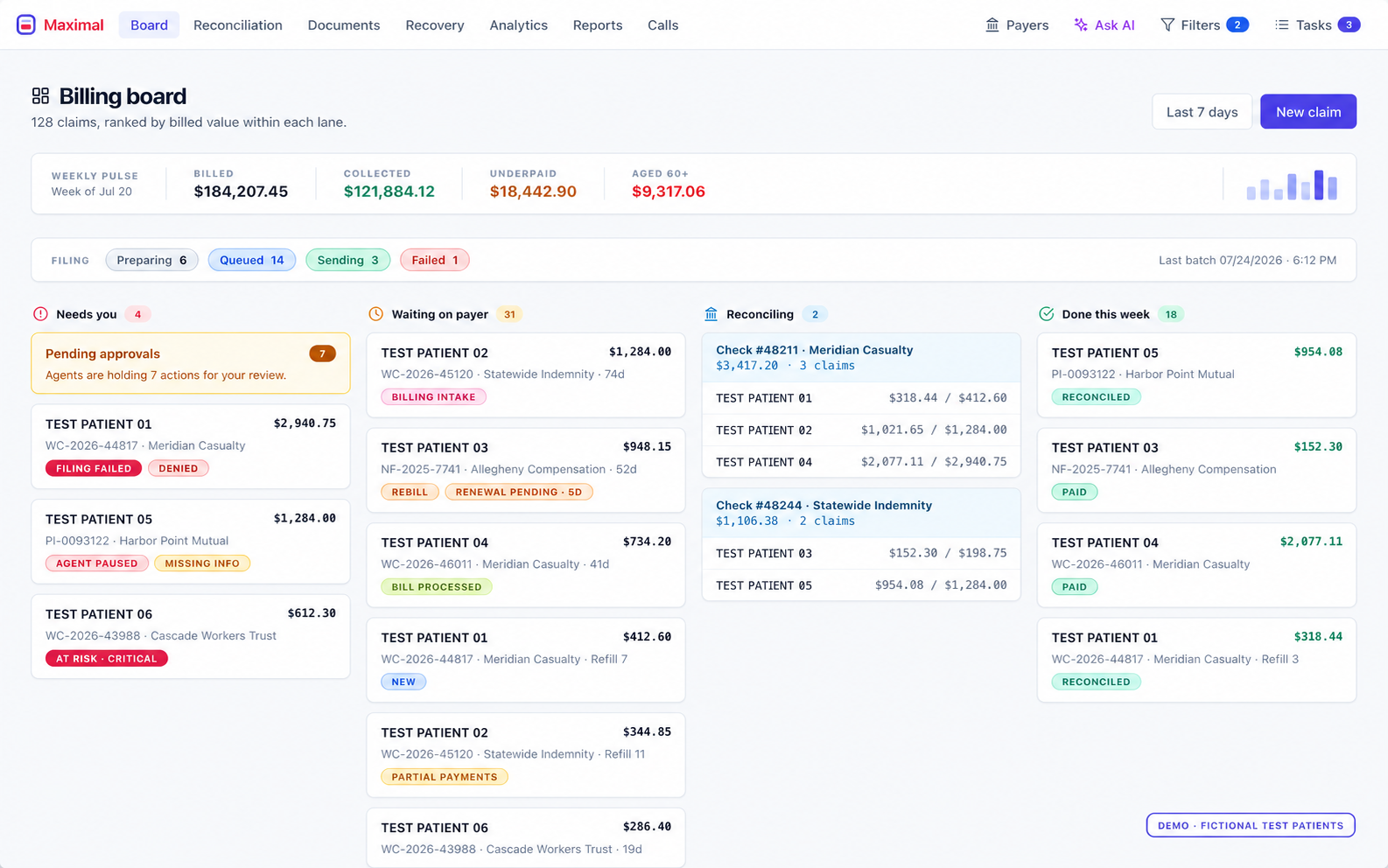
Rolling out with the current shell work: the Board (every claim in four lanes, ranked by dollar value), a single Approvals queue, and the Agents run viewer. The approval gate itself already runs underneath every action.
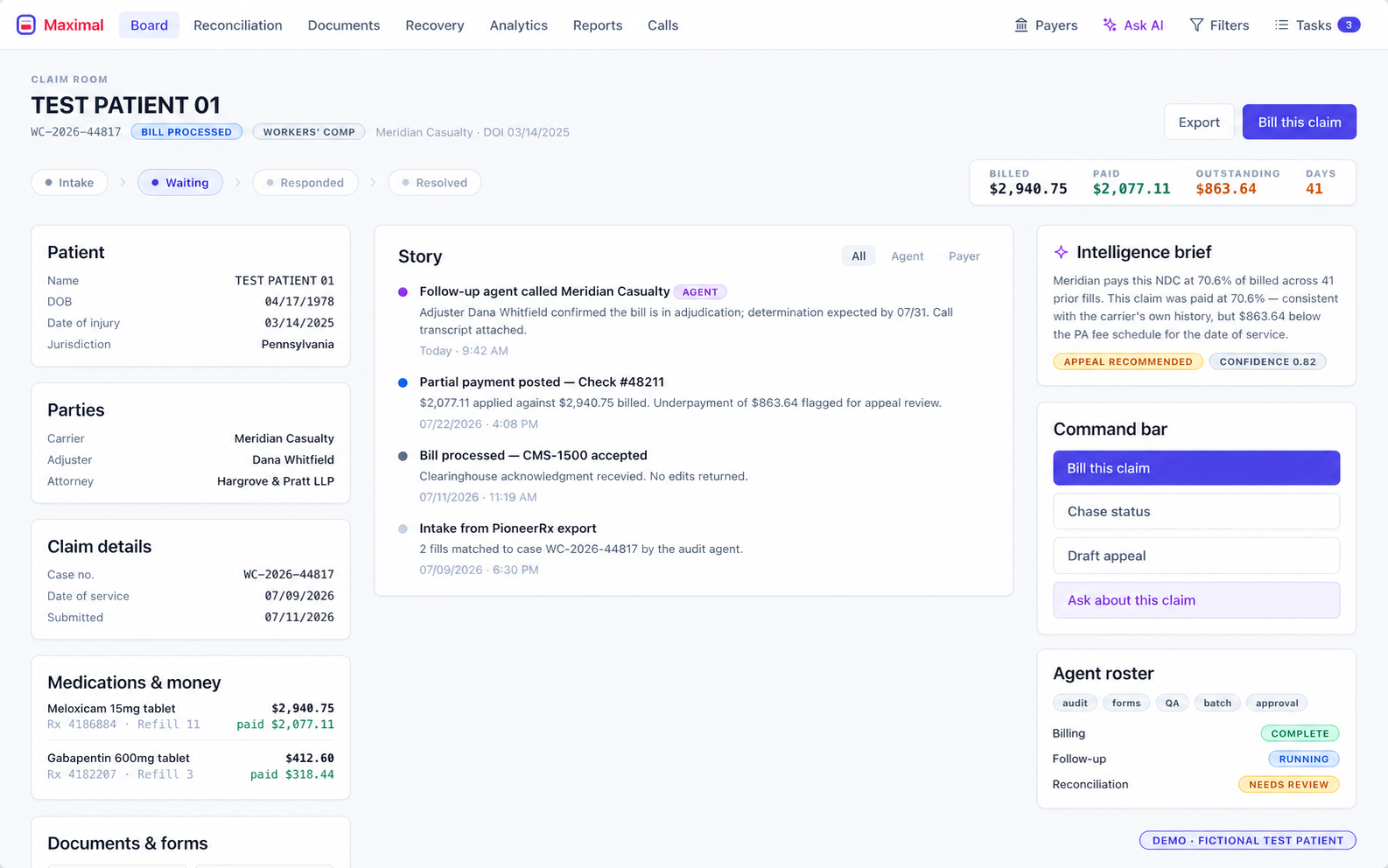
“Your team works the claim in one place — not an inbox and a spreadsheet.”
| Manual today | With Maximal | |
|---|---|---|
| Intake | Biller eyeballs the file; a missing employer surfaces days later. | Billing Agent checks it instantly, auto-fills from claim history. |
| Form prep | CMS-1500 + LIBC-9 filled in by hand, claim after claim. | Generated on demand, correct state form auto-selected. |
| QA | “Looks right to me.” | AI vision inspects the rendered PDFs for overlaps, cutoffs, blanks. |
| Batching | Print, order, fax, log it somewhere. | Batch staged → one approval click → delivered and tracked. |
| Waiting | Claim sits; nobody notices for 6+ weeks. | Silence past your threshold opens a follow-up with full context. |
| EOB & posting | Someone reads the PDF and keys each line. | Reconciliation Agent splits, extracts, matches; reconciler reviews a draft. |
| The story | Scattered across email, memory, sticky notes. | One timeline on the claim — forever traceable. |
Redeployed from data entry to working denials and appeals — which is where the money actually is.
Conservative illustrative model — a representative injury provider or pharmacy (~3,000 claims/yr, ~$4M annual collections). Your numbers will vary; this is modeling, not a guarantee.
~1.75–2.0 FTE of manual effort returned to higher-value work. Grow volume without growing the team.
Same-day submission, EOBs posted in days not weeks, reconciliation closing weekly not monthly.
Every claim is paid, denied, or actively chased. Recovering even 1–2% of leaked revenue on a $4M book is $40–80K/yr.
Pre-submission checks + vision QA catch missing data and malformed forms before a payer ever sees them — each avoided rejection saves rework and weeks of delay.
Illustrative modeling on a representative book, not instrumented results. We measure these with design partners rather than quoting someone else's numbers.
Every agent run, decision, and approval lands on the claim's timeline with a name attached. Nothing consequential happens without a person clicking approve — that gate is architecture, not policy.
Nothing sends, posts, or merges without a click. Sending a batch is always approval-gated — by architecture.
Posting won't run on an unreviewed EOB until identifiers — patient, claim ID, Rx numbers — are confirmed.
A claim that fails its checks doesn't get billed wrong; it pauses with a precise, human-readable issue list.
Every claim, EOB, call, and denial feeds a per-payer behavioral profile: median days-to-pay, first-pass denial rate, top denial reasons, billed vs. paid. Follow-up thresholds and appeal strategies get set from evidence, not folklore.
Sample profile shown with fictional data.
Recorded PIP-exhaustion tracking · LLM denial analysis and appeal drafting · deterministic dose-safety math — every one of them behind an approval.
Deterministic checks first, AI second. We instrument the numbers with design partners rather than quoting someone else's.
Product and technology, billing operations, pharmacy, and healthcare analytics in the room together. You talk to us directly, not to a sales layer.
Builds the agents, the approval gates around them, and the record every run leaves behind. Designs the system so nothing sends, posts, or merges without a human click.
LinkedIn
Practicing pharmacist. Advises on the pharmacy end of the injury claim — what dispensing and documentation really look like before a claim ever reaches a payer.
LinkedInAnalytical healthcare background paired with seasoned enterprise sales. Translates what the data shows into what a provider or pharmacy actually needs to hear.
LinkedInStart with ninety days of your own claims, scanned. You see the number — with the source records behind it — before you pay anything.
Get your free assessmentFree, not fake: real exports, a signed BAA, and findings you can open claim by claim.